
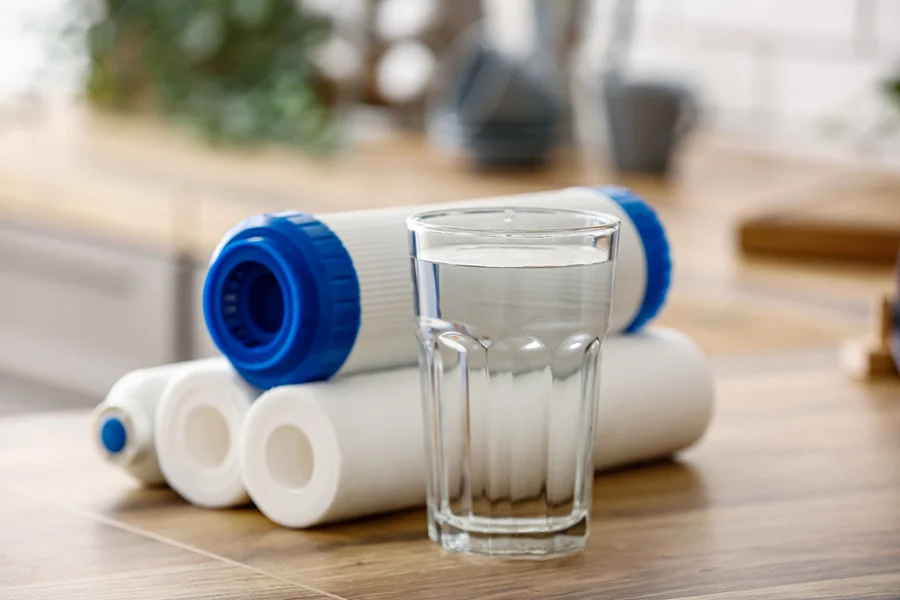
Knowing how to choose a water filter is essential for ensuring your family has access to clean and safe drinking water every day. The article describes many kinds of water filters, with a particular emphasis on RO (reverse osmosis) filters. Water via borewells, pipelines, or industrial regions that has a total dissolved solids, or TDS, level higher than 300 ppm is best suited for these filters. In order to remove salts that are dissolved, metals such as arsenic, fluoride, nitrates, and other impurities, RO filters use a semi-permeable membrane. RO filters have several benefits, such as improving the flavour of potentially metallic or salty water and effectively lowering excessive TDS and dangerous metals. Nevertheless, they have drawbacks include wasting some water, sometimes eliminating necessary minerals unless a mineraliser is added, as well as being more expensive than alternative filtration methods.
Important Water Parameters To Assess Are As Follows
- TDS (Total dissolved Solids), in which the ideal range for consuming water is 50–150 ppm; filtration techniques like RO are suggested if TDS goes above 300 ppm;
- Hardness, which may trigger scaling, affect the health of hair and skin, and change taste, requiring more powerful treatment techniques such as RO for mineral-rich water;
- Lower TDS ( Total Dissolved Solids) water from municipal supplies is best suited for UV (Ultraviolet) filters. Their main purpose is to employ UV light for cleaning in order to get rid of germs, viruses, and bacteria without changing the flavour of the water. Water waste is eliminated, purification happens quickly, and UV purifiers are reasonably priced.
Understanding how to choose a water filter (เครื่องกรองน้ำเลือกยังไง, which is the term in Thai) can help you select the right purification system for your home’s specific water quality needs. They make use of a barrier that successfully keeps out impurities including dust, muck, bacteria, and cysts. You can use a TDS meter (which costs between 200 and 500 online), a water testing facility, the town’s reports, or your neighbours to test your water. This guide offers advice on choosing water filters, with a special emphasis on vital features and budgeting. The following are the pricing criteria for various filter types: Gravity filters cost between ₹1,500 and ₹4,000, UF/UV filters between ₹5,000 – ₹10,000, RO+UV filters between ₹10,000 and ₹20,000, – RO+UV+UF+Mineralizer filters between ₹12,000 and ₹25,000. It also highlights important features to take into account, such as a Mineralizer/TDS Controller to retain vital minerals, a suitable storage container capacity (7–10 litres for small households and 10–15 litres for large families), a filter change warning for maintenance alerts, Copper/Alkaline technology for flavour improvement and health benefits, and the significance of choosing brands with a strong local service network. You can choose the best purification system that meets your home’s unique water quality requirements by knowing how to choose a water filter.
